
What Ware County Deed Records Contain
The Ware County Clerk of Superior Court records more than conveyance deeds. The office also files plats, liens, UCC filings, releases, and related land instruments. Classify each instrument before placing it into an ownership chain.
| Deed Type | What It Does | Common Use |
|---|---|---|
| Warranty deed | Conveys land with stated title promises | Ordinary sale or transfer |
| Quitclaim deed | Conveys whatever interest the grantor may hold | Corrective or family transfer |
| Executor or administrator deed | Conveys under estate authority | Probate-related transfer |
| Security deed | Secures a debt against land | Financing, not a sale alone |
| Release or satisfaction | Releases a prior recorded claim | Closing a lien trail |
A good index entry names the parties, the instrument type, the recording date, and a book/page or instrument number. Read it carefully. A security deed or lien burdens the property without conveying it, so it is not the same as a transfer deed. PT-61 transfer data may state the consideration, yet it is not the deed itself.
The Ware County Clerk Holds the Record
The Clerk of Superior Court is Ware County's recorder. The office sits at 800 Church Street in Waycross. Mail goes to P.O. Box 776, Waycross, Georgia 31502, and the telephone is (912) 490-4340. Visitors may inspect available records at the counter and request plain or certified copies. The clerk publishes no Ware-specific certified-versus-plain copy schedule, so confirm current cost, payment, delivery, and certification before ordering. Give staff a party name, an approximate recording date, an instrument type, and a book/page reference. That keeps a search focused.
Search Ware Deeds through GSCCCA
The GSCCCA name form is the main online route when you have a grantor or grantee. Select Ware County, enter the party, choose an instrument type when known, and use a reasonable date. Book/page and the subdivision-and-lot search offer solid alternatives.
| Field | Use | Caution |
|---|---|---|
| Grantor or grantee | Find conveyances by party | Try initials, suffixes, entities, and estates |
| Instrument | Separate deeds, liens, plats, and releases | Not every filing transfers land |
| County and date | Reduce unrelated hits | Recording date can differ from closing |
| Book/page | Retrieve a known reference | Older images may need the clerk |
The statewide index visibly begins January 1, 1990. Ware's exact good-from date and any older image cutoff still require confirmation from the clerk.
Read the Ware County Name Form
The official GSCCCA form pictured below exposes party, county, instrument, and date controls.
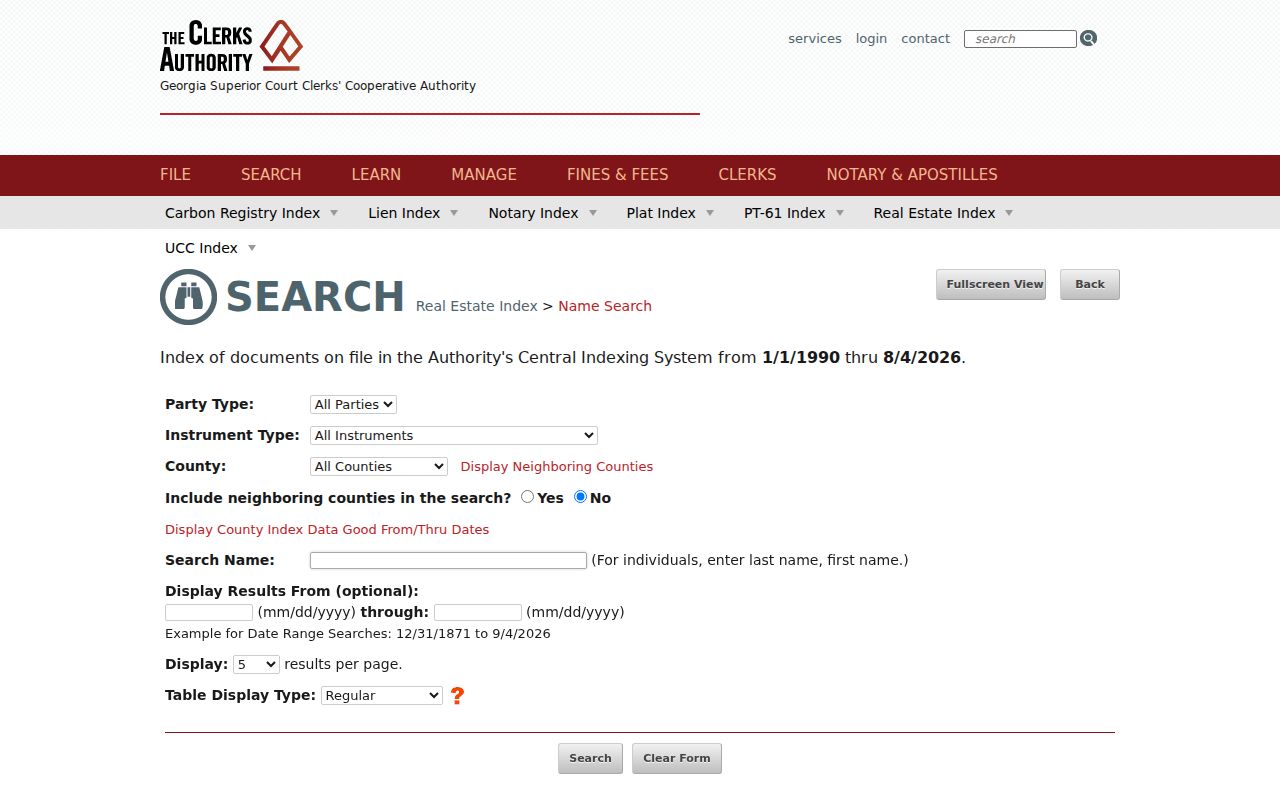
Treat the name form as a doorway, not an answer. Match each result to the parcel and its legal description before placing it in the chain of title.
Walk Ware County's Grantor-Grantee Chain
A grantor conveys an interest, and a grantee receives it. Start with the newest confirmed deed, then work backward. Match the same land description at every step.
- Find the apparent current owner's acquisition by searching that name as grantee.
- Read the grantor, deed type, recording date, and full legal description.
- Search that grantor as an earlier grantee.
- Repeat only while lot, subdivision, land lot, district, plat, and deed clues continue to match.
- Open probate or court records when an estate, heir, order, or tax sale breaks a simple sequence.
- Grantor
- The party conveying an interest.
- Grantee
- The party receiving that interest.
- Chain of title
- The linked sequence of recorded transfers for the same land.
- Book/page
- A volume and page reference used to retrieve an image.
- Instrument number
- A distinct reference assigned when a document is recorded.
Bridge Older Ware County Deed Books
Older records may live in deed books, plats, microfilm, or archival finding aids. The Georgia Archives county collection holds tax digests and Superior Court material such as deed books. It also holds probate records. A catalog result may describe a reel rather than show an image. FamilySearch's Georgia Wills and Deeds collection covers roughly the 1700s through 2017. Access is subject to holdings, account rules, and image limits.
Ware County dates to 1824. Waycross grew from Tebeauville and incorporated in 1874. An old chain can predate any modern street address. Search party names, land lot, district, subdivision, and book/page instead. The Ware reel and volume ranges are not published online.
Watch New Ware Filings with FANS
The free Filing Activity Notification System sends alerts when a chosen name or address shows new activity in real-estate, lien, plat, or UCC indexes. It is not a historical deed search. Nor is it a guarantee against fraud. The official service page shows the signup and alert options.
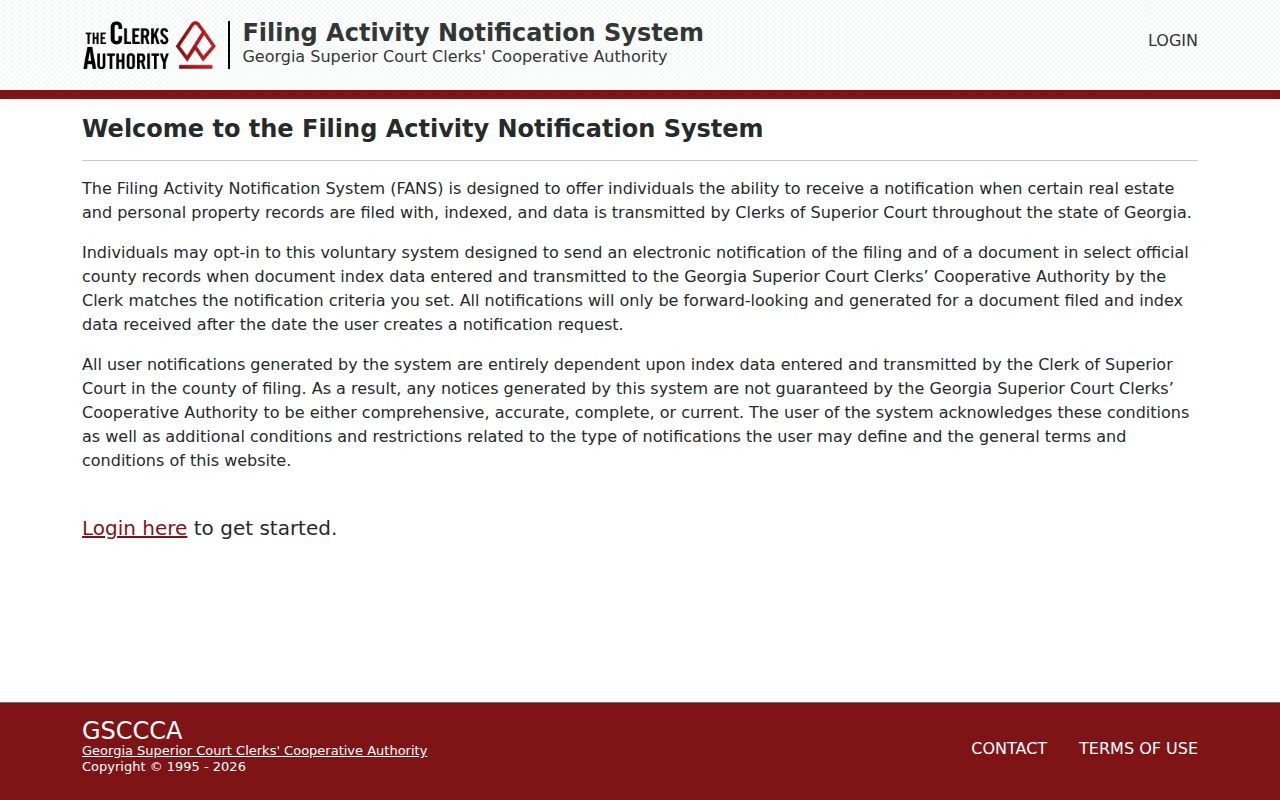
An unfamiliar alert should lead to the actual instrument and a call to the Clerk, not to assumptions about what occurred. Note: Name variants and clerk-index limits can keep a relevant filing from matching an alert.
Cross-Check a Ware Legal Description
A 2026 tax-sale notice tied parcel 036C 03 012 to Lot 15 Block 4 of B.F. Dryden Subdivision, Land Lot 76, 8th G.M. District. The plat is Book A page 493. The deed is Book 63Z page 339. That makes it a discovery source, not a verified deed image. Test each clue in GSCCCA, the recorded plat, GIS, and the tax system. This approach beats matching a common party name. A current parcel number can change after a split or merge. A full legal-description trail, though, may still reconnect the land.
Get a Ware County Deed Copy
Begin with the index reference. Then check GSCCCA or the county's PeachCourt destination for the image. Account, search, image, or print charges may apply. If no image exists, request counter inspection or a mailed copy from the Clerk, and state whether you need a plain informational image or a certified copy.
Recorded, not guaranteed. Ware's deed index shows filed instruments, not a title opinion. Unrecorded interests, defects, and competing claims may still exist.
For the address-to-parcel lookup that comes before a deed search, use the Ware County property search. Deed copies answer what was filed. Professional title review answers broader ownership and encumbrance questions.
Verify Each Ware Deed Index Result
A promising name hit deserves a full capture. Save the exact grantor and grantee spellings, the document type, both the signing and recording dates when the page shows them, and the book and page or instrument number. Add the county, any legal-description clues, and whether an image exists. The price field may be blank. Never plug in a tax value to fill it; that figure comes from a different source and serves a different purpose.
Same-name parties call for more than a name match. Weigh the land description, subdivision, lot, adjoining-owner language, mailing hints, and the order of later filings. Follow a spouse, trustee, estate representative, or exact entity name when the deed points there. Georgia's corporation search can settle an LLC's spelling. It cannot prove that the entity owns the parcel.
Pair security deeds, assignments, cancellations, and releases by their references. A release closes an encumbrance trail. A conveyance deed advances the ownership chain instead. Keeping those paths apart stops a loan document from masquerading as a sale.
Request Missing Ware County Land Records
When neither GSCCCA nor PeachCourt supplies the image, ask the Clerk to inspect or copy the cited record. A precise request names Ware County, the parties, the record type, the approximate date, the book/page or instrument number, and whether certification is needed. Mail service runs through the Clerk's post-office box. The courthouse counter handles volume and index questions.
Older records raise a different question. Ask whether the deed book or plat sits at the courthouse, on microfilm, or with an archival custodian. Under the Georgia Open Records Act, a request may seek inspection or copying of existing records. It cannot force staff to build a new title abstract. The agency generally responds or acknowledges within three business days. A lawful cost estimate may follow.
Georgia Archives offers a second route through county-record finding aids covering Superior Court deed material, probate files, and tax digests. FamilySearch holds a statewide Wills and Deeds collection spanning roughly the 1700s through 2017. Its probate collection runs from 1742 to 1990. County coverage and image restrictions vary. Use those sources to find an older book or party. Then return to the Ware Clerk when a certified record or current legal reliance matters.
Historic Waycross creates an address problem. The community began as Tebeauville beside a railroad station and incorporated in 1874. An early instrument may cite a rail corridor, land lot and district, plat, subdivision, or old place name rather than a modern street number. Carry every legal-description term forward. The Waycross Historic District boundaries and named landmarks can narrow the hunt. A district record is not itself a deed restriction.
When an estate enters the chain, the Probate Court file may confirm an executor or administrator's authority. The recorded executor, administrator, or heir deed remains the actual land-transfer record. Search the decedent, the estate, the representative, and later grantees while matching the same description. That discipline keeps a will or obituary from being treated as if it changed the Ware County deed record on its own.
Liens and security deeds need their own trail. Match each release, cancellation, assignment, or satisfaction to the original parties and book-and-page reference. A paid loan may linger in the index. An assignment can swap the secured party while the owner stays the same. Easements and covenants may sit in a deed, a separate instrument, or a plat. Read the image and all cited exceptions before concluding that an encumbrance was created or cleared.