
Build the Ware County Former-Owner Timeline
Start with a confirmed current deed. From there, work backward through Ware County property records one transfer at a time, logging the buyer, the seller, the instrument type, and the land reference for each row. Resist the urge to patch gaps with details from a similar parcel, since a mismatched parcel number can quietly corrupt the whole chain.
| Transfer date | Grantor to grantee | Deed type | Book/page or file number |
|---|---|---|---|
| Newest verified recording | Immediate former owner to current grantee | As indexed and shown on image | Copy exact reference |
| Earlier verified recording | Earlier owner to immediate former owner | Warranty, quitclaim, executor, or other actual type | Copy exact reference |
| Next earlier recording | Prior grantor to prior grantee | Read the instrument | Carry forward to older index |
Names by themselves prove nothing about continuity. At every transfer, match the legal description and note any reservations, exceptions, replats, or correction instruments that could reshape the chain.
Walk Ware County's Deed Chain Backward
The GSCCCA name search lets you set county, party type, instrument type, name, index and results date ranges, neighboring counties, row count, and display type. Those filters do the narrowing for you. Use them to steer a historical ownership trail toward the records that matter.
- Find the current grantee's newest deed and record its legal description and book/page.
- Read the grantor, who is normally the immediate former owner for that transfer.
- Search that grantor as a grantee to find how the prior owner acquired the same land.
- Repeat while the parcel description matches, then shift to book/page, subdivision/lot, older deed books, or microfilm when online indexing ends.
Search exact and alternate name forms, including spouses, entities, trustees, executors, and estates. A shared name is never enough. A homonym only counts as a former owner when the land description matches too.
Ware County's Online Cutoff Is Not Fully Settled
GSCCCA lists an index-from date of January 1, 1990. That single figure does not settle Ware County's earliest indexed instrument, its image coverage, or any missing book ranges. Treat the statewide screen as a starting point, not proof of complete county coverage.
Coverage limit. Ask the Ware Clerk for county good-from dates and book gaps; former owners before online coverage remain in deed books, plats, or microfilm.
For questions the portal cannot answer, call the Clerk of Superior Court at (912) 490-4340 or visit 800 Church Street in Waycross. Mail requests go to P.O. Box 776, Waycross, GA 31502. Include the known book/page, names, legal description, and date span.
Older Ware County Owners Live Beyond the Portal
Ware County was created in 1824 from Appling County. So its land record reaches well before any digital index. The Clerk of Superior Court remains the local custodian of recorded instruments. For the deeper layers, Georgia Archives county records catalog deed books, tax digests, and probate microfilm. A finding aid describes what exists. But it does not promise every image is viewable online.
| Older source | What it can add | Access caution |
|---|---|---|
| Clerk deed books and indexes | Earlier grantor-grantee links and instrument text | Exact Ware run and copy fees need confirmation |
| Recorded plat books | Subdivision, lot, block, replat, and vacation history | GIS is not the recorded plat |
| Georgia Archives tax digests | Taxed names and property clues by year | Holdings may be finding aids or microfilm |
| FamilySearch wills and deeds | Georgia collection spanning about the 1700s through 2017 | County, account, and image restrictions vary |
| Probate records | Executor authority, wills, heirs, and estate transfer context | Confirm the resulting land transfer in a deed |
No exact Ware reel series or complete local directory run is documented. Leave that gap open. Inventing coverage dates would only mislead the next researcher.
The B.F. Dryden Record Shows How Clues Join
A 2026 Ware County tax-sale notice offers a lesson in record vocabulary: parcel 036C 03 012, 2.76 acres, Lot 15 Block 4 of B.F. Dryden Subdivision, Land Lot 76, 8th G.M. District, Plat Book A page 493, Deed Book 63Z page 339, and Church Lane. A notice is not a deed image. It cannot by itself establish a full former-owner chain. Its value lies in method. Search each identifier separately. Then compare what comes back. The plat can anchor the lot. The deed reference points to an instrument. The parcel string ties the tax and GIS records together. Preserve spaces and leading zeroes rather than normalizing the parcel ID. Note: A current legal notice works as a cross-reference map for research, not proof that every stated interest remains unchanged.
Read Ware County Grantors, Grantees, and Deed Types
The grantor conveys an interest. The grantee receives it. Chain of title is the ordered set of instruments carrying those interests through time. A reverse index opens the records through grantors, while a direct index works from grantees.
- Warranty deed
- A conveyance whose actual warranties must be read in the instrument.
- Quitclaim deed
- A transfer of whatever interest the grantor holds, without proving that interest is complete.
- Executor or administrator deed
- A conveyance tied to estate authority and probate context.
- Correction deed
- An instrument that may repair a name or description rather than signal a new sale.
- Security deed
- Georgia lien terminology; it should not be mistaken for an ordinary ownership transfer.
Assignments, releases, easements, tax deeds, foreclosure deeds, and plats all help explain the record. Not every instrument adds an ordinary owner, though each one belongs in the chain.
Probate Can Interrupt a Simple Ware County Chain
A death transfer can involve a will and a petition. It may also involve executor or administrator authority and heir information. A court order and a later deed often follow. Ware Probate Court sits at 800 Church Street, Suite 123, Waycross. It answers at (912) 490-4315. Court files explain who held authority. The recorded land instrument still confirms the conveyance itself. Search the deceased owner's name and the estate name. Also search the personal representative and any heirs named in the deed. Include the legal description. A probate beneficiary did not automatically become the recorded owner. Find the instrument or court action that actually touched the land.
Inspect Ware County Deed Search Screens
The official GSCCCA name form is the standard starting point for digging up earlier owners.
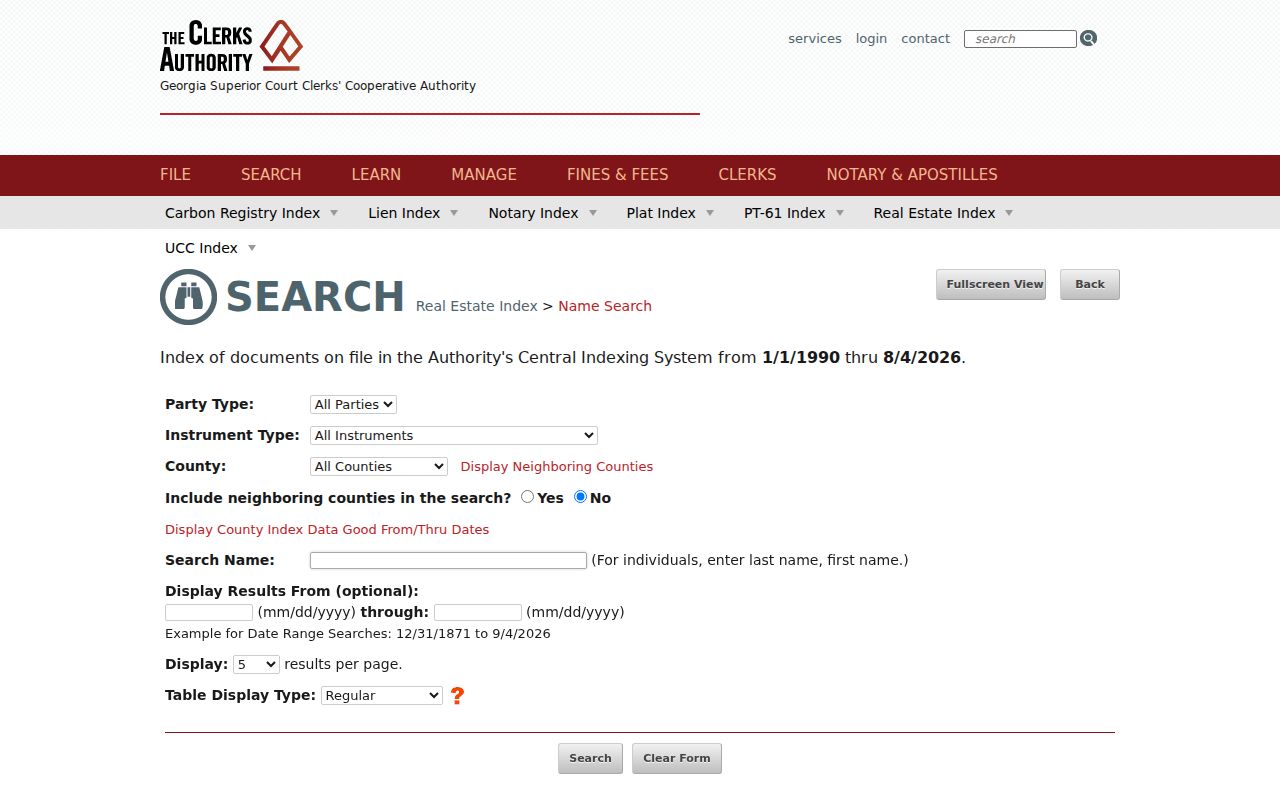
County, party, instrument, name, and date controls make each backward step reproducible, though viewing results and images depends on account access. For a subdivision chain, the GSCCCA property form opens a second route. Run it alongside the name search.
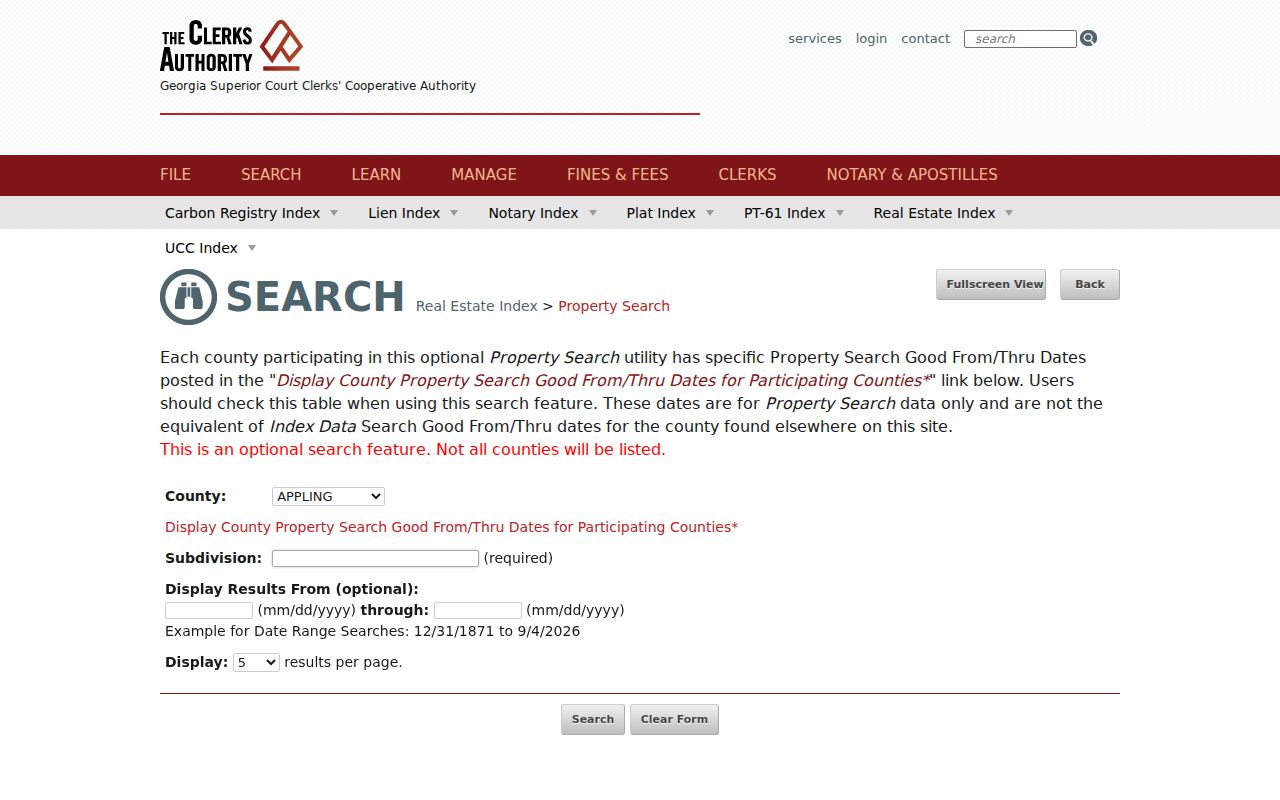
Subdivision and lot searching helps most when an old deed carries no modern street address at all.
Know When the Ware County Chain Must Stop
Know when to stop. Halt if a legal description stops matching. Halt if a name cannot be distinguished. An index gap that blocks the next link is another stopping point. The same goes for any question that needs a title opinion. Return to the Clerk, the plat, the tax digest, or the probate file rather than guessing. GSCCCA index summaries and PT-61 data are discovery tools, never substitutes for the recorded instrument.
Lawful research. Former-owner records support house history, estate work, and land diligence. Never use them to stalk, harass, intimidate, or harm a living person.
The public backward chain is a research trail, nothing more. It does not certify marketable title. Get the official record before you rely on it. Then seek a professional review for a legal or transactional conclusion.
Older Waycross land can hide under names that predate its current street numbers. The city grew around a railroad station before its 1874 incorporation. A modern address is often the weakest historical key. A parcel may appear under Tebeauville instead. It may also show up along a rail corridor, in a historic district, or under a lot-and-block label. Carry the subdivision, land lot, district, plat citation, and every former place label with you. All of it belongs in the older deed index.
Tax digests can bridge the years when a deed index turns hard to use. Still, a taxed name is not automatically a grantee. The city publishes no reliable Waycross directory run. Never assign invented years to fill a gap. Treat a directory entry, obituary, cemetery note, or newspaper mention as a lead only. Then return to the deed, probate order, plat, or tax record for support.
A strong chain log records why each step earns its place. Note the legal-description match, the prior deed citation, any name variation, and every gap you find. Two tracts can share an owner or subdivision name. Acreage and lot details can prevent a false link. If those identifiers conflict, ask the clerk for the older index rather than forcing the timeline onward.