
Four Ware County Property Value Figures
One parcel can carry several figures because each answers a different question. Ware County's Board of Assessors sets fair market value for the digest. Georgia generally assesses real property at 40 percent of that figure. The resulting assessed value is not a recorded sale price, and it is not what a buyer might offer today.
| Value | What It Is | Where |
|---|---|---|
| Fair market value | The assessor's estimate of an arm's-length price between informed parties | Ware Board of Assessors parcel record |
| Assessed value | Generally 40 percent of fair market value under Georgia's standard framework | Assessment record and annual notice |
| Taxable value | The amount remaining for tax calculations after applicable exemptions or programs | Assessment and tax records |
| Recorded sale price | Consideration tied to a past transfer, if shown in deed or PT-61 research | GSCCCA deed and transfer records |
A land-and-improvement split is simply another view of the assessor's estimate, not a fifth market quote. Always note the tax year and displayed update date along with the number. Skip the date and comparisons can mix different digest cycles.
Georgia's 40 Percent Rule in Ware County
The Georgia Department of Revenue explains that real property is generally assessed at 40 percent of fair market value. A parcel with a fair market value estimate should show a lower assessed figure. This follows the standard framework in Ware County. Special programs, including some agricultural or farmland treatment, follow different statutory rules.
The ratio does not predict a sale. It converts the assessor's fair market estimate into an assessed amount for the property-tax system. Exemptions can then lower the taxable figure. The assessor's underlying view of fair market value does not change.
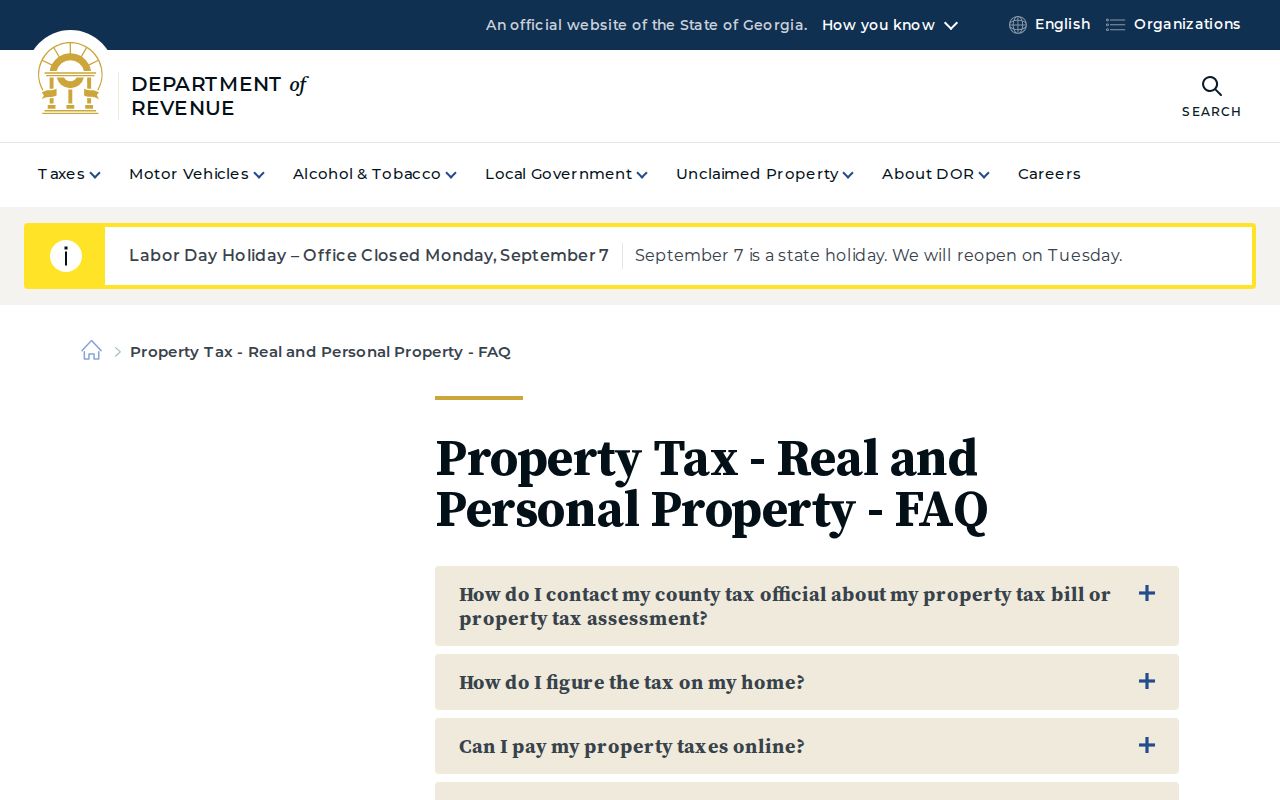
The Georgia property-tax FAQ displays this statewide framework. The official page spells out the distinction behind Ware County values rather than any private estimate. That distinction is why it is worth reading in full.
Read that rule beside the parcel's year and exemption fields. The ratio alone never explains every displayed total.
How Ware County Builds Its Value Record
The Ware County Board of Assessors reports responsibility for about 25,000 real-property parcels. It also covers about 5,000 personal-property accounts. Its staff prepares land, residential, commercial, and industrial digest material. The office runs monthly sales-ratio studies. These test how assessed values relate to market activity across groups of property.
This is mass appraisal. It values a tax base consistently rather than inspecting a single house for a sale. Condition changes, unusual terms, or a very recent market move may not show up the same way. They may not appear as quickly as they would in a private appraisal.
Look Up a Ware County Assessed Value
The official starting point is the Ware qPublic parcel search. It offers owner, address, parcel-number, and map modes for pulling up a parcel card. Use only the fields actually displayed on the parcel you open, and do not infer a value history the card does not show.
- Open the Ware County qPublic search and locate the property by address or parcel number.
- Confirm the situs, parcel identifier, acreage, and legal description before reading any value.
- Capture fair market, assessed, land, improvement, exemption, and tax-year fields that appear.
- Search the latest deed and PT-61 material when a recorded transaction price is needed for comparison.
- Call or visit the Board of Assessors when a card is inaccessible or its year is unclear.
- Assessed value
- The value produced after applying the applicable assessment level to fair market value.
- Fair market value
- The amount an informed buyer would pay and an informed seller would accept in an arm's-length transaction, as the county describes it.
- Assessment ratio
- The share of fair market value used to produce assessed value, generally 40 percent in Georgia.
- Sale or consideration price
- A transaction figure tied to a transfer, not a present appraisal.
- Reassessment
- A new review or update of the value carried for a tax cycle.
Recorded Sales Give Ware County Values a Date
A deed records a conveyance. It does not promise that the stated consideration equals an open-market price. Family transfers, quitclaims, and estate work can make a deed amount a poor comparable. Other transactions can too. When the latest transfer matters, search GSCCCA by the current grantee. Recording date, book and page, or legal description also work as search terms.
Keep the recording date and transfer details beside any price. A years-old sale is historical evidence. The assessor's current fair market value belongs to a later digest. Comparing the two can be informative only after the dates and transaction type are clear.
GSCCAA offers name, book-and-page, and subdivision-and-lot routes. Its statewide real-property screen displays an index beginning in 1990. Ware County's precise good-from date and image cutoff vary. For an older instrument or an image that is unavailable online, ask the Clerk of Superior Court. Account and fee terms may apply to images and printing. Treat the index result and the obtained document as separate stages.
Ware County Digest Notices Are Countywide Context
Ware County published five-year digest and millage notices in 2025. It announced 2026 digest and millage material again. These public notices explain countywide change and the setting in which assessments occur. They do not prove that one home rose or fell by the same amount.
Use digest history to ask better questions. Then return to the parcel card. Use the annual assessment notice for the property-specific record. Ware's monthly sales-ratio work supports systemwide review. But the public pages offer no Waycross-only trend series. A city trend should not be invented from county totals.
A five-year digest table can show how broad classes and totals changed. It says little about one roof, addition, land split, or exemption. Match parcel-level facts to the same tax year before drawing any conclusion. If a displayed value jumps, request the existing card history or notice. Do not guess the cause was a sale.
Exemptions Change Taxable Value, Not Market Evidence
Homestead and similar exemptions lower what gets taxed. But they do not erase the numbers a value shopper cares about. Fair market value and assessed value stay on the card as separate figures. Georgia ties ordinary homestead eligibility to ownership and occupancy rules plus a filing calendar. Even so, the exemption result is not a discount a future buyer can bank on. Ware County property records reflect this split clearly.
Compare similar parcels with care. Two homes can carry the same assessor market value yet show very different taxable amounts. Their exemptions or special programs differ. Questions about bills, exemption filing, or appeals go to the Board of Assessors and the Tax Commissioner. The Ware County property tax records guide covers those procedures.
Offline Routes to a Ware County Property Value
When qPublic will not load, walk in or call the Board of Assessors at 305 Oak Street, Suite 154, Waycross. Published weekday hours run 8:30 a.m. to 4:30 p.m., and the phone is (912) 490-4383. Ask for the parcel's current card, the applicable tax year, and any public value-history fields. Do not ask staff to estimate a sale price. That is not their role in maintaining property records.
A Georgia Open Records Act request can seek card-level or digest data in a defined format. Agencies generally respond within three business days. Otherwise they provide a production timetable and a cost estimate. For a transaction amount, go to the Clerk of Superior Court instead. You can also use GSCCCC deed records. Each channel yields a different record. Keep the source date with whatever you obtain.
Mail and counter access still matter in some cases. A portal may block a browser, or an older value may be missing. State the parcel number, situs, and the year range you want. Say whether you prefer inspection or an electronic copy. A focused request lets the custodian pull an existing record quickly. It also keeps the ask from drifting into a demand for a new appraisal.
What Ware County Property Value Cannot Prove
An assessed value exists for tax administration. It can lag what is happening on one parcel. It does not certify structural condition, fix a boundary, or disclose every private restriction. A tax bill adds collection details, not a market appraisal. Ware County property records support valuation research, but they cannot guarantee an achievable sale price.
Value is not price. A Ware County assessed value is not what the property will sell for. A parcel-specific market conclusion requires a qualified appraisal.