
Fields in Ware County Property Tax Records
Two ledgers, two owners. The Board of Assessors holds the facts describing each tax parcel and its valuation. The Tax Commissioner, meanwhile, holds the facts describing the charge and how it was collected, so knowing which office keeps a field makes any record easier to read.
| Field | What It Shows | Where |
|---|---|---|
| Fair market value | Assessor's estimate under state law | Board of Assessors |
| Assessed value | Value used before exemptions and calculation | Assessment roll |
| Exemptions | Approved reductions such as homestead | Assessor account |
| Tax bill and status | Charge, payments, balance, delinquency | Tax Commissioner |
| Tax district and millage | Jurisdictions and rates applied | Digest and bill |
Georgia sets assessments at 40 percent of fair market value. Exemptions lower taxable value without touching the market estimate. Because of that gap, a bill is a tax calculation, not an appraisal, a sale price, or any kind of ownership instrument.
Ware's Two Property Tax Offices
The Board of Assessors maintains the parcel roll, handles exemptions, prepares the digest, and runs monthly sales-ratio work across roughly 25,000 real parcels. The Tax Commissioner handles the billing side. That office issues bills, collects payments, tracks delinquency, runs tax sales, and holds excess funds. The collector's office sits at 305 Oak Street, Suite 115A, in Waycross. Hours are weekdays, 8:30 a.m. to 5 p.m. Each lane matters. A paid bill proves no title. The roll's owner of record can also lag a recent deed, so valuation questions go to the assessor and payment questions to the Tax Commissioner.
Decode Ware County Tax Terms
Keep the label and year attached to every number.
- Fair market value
- The assessor's estimate under Georgia's statutory standard.
- Assessed value
- The assessment-level value, generally 40 percent of fair market value.
- Homestead exemption
- Approved relief tied to eligible owner occupancy.
- Millage
- The rate used with taxable value to calculate tax.
- Tax lien
- A claim arising from unpaid tax, subject to release and collection rules.
Homestead status offers an occupancy clue, not proof of residence or title.
Georgia Rules Behind Ware Assessments
The Georgia Department of Revenue FAQ lays out the state value and appeal framework that Ware applies.
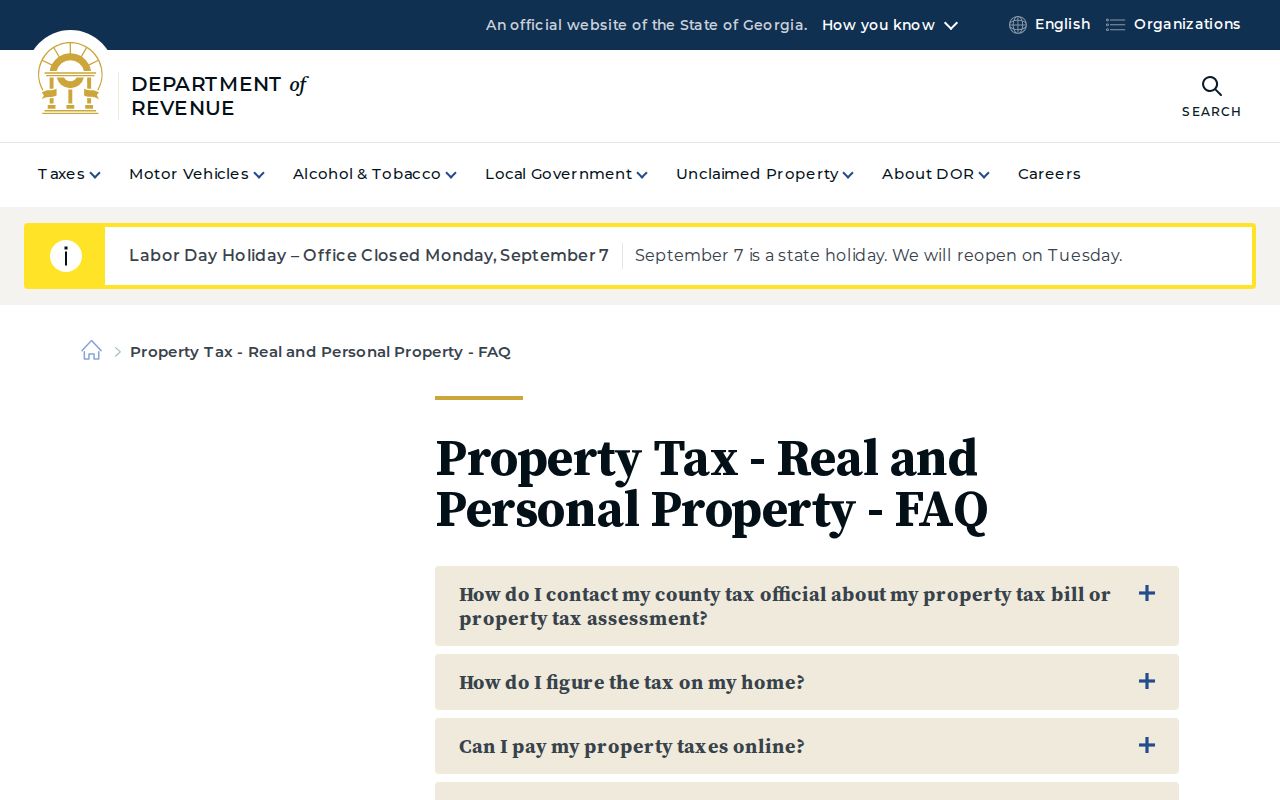
State rules define the system, while Ware's own parcel roll and annual notice govern a specific property.
Look Up a Ware County Tax Bill
The Tax Commissioner routes search and payment through GovernmentWindow. Use only the fields on the live screen. Start with a parcel number copied from qPublic or the GIS map. The accepted street address or tax-account key works as a backup.
- Open the current official Ware tax destination.
- Search the accepted parcel, account, or address field and verify the legal description.
- Select one tax year and separate billed charges from posted payments.
- Compare exemptions with the assessor record.
- Call the Tax Commissioner for certified status or help with a blocked result.
- Assessment
- The assessor's value determination for a year.
- Levy
- The tax produced after values, exemptions, and rates are applied.
- Delinquent
- Past due and subject to current collection rules.
- Excess funds
- Tax-sale surplus handled through a separate claim process.
Ware Tax Sales and Excess Funds
The tax-sale page and excess-funds page are separate trails at the Tax Commissioner's site. A sale list is not claim-free land. Payment, correction, withdrawal, bankruptcy, redemption, or legal-description problems can all change a property's standing before or after a sale.
A 2026 local notice listed the taxpayer or record holder, parcel, legal description, deed and plat references, sale rules, and sale place. Use it for discovery only. Then verify the live tax account, the clerk's filings, any redemption, and the later deed of record. Excess funds require claimant proof. They do not show current ownership.
Ware's Five-Year Digest Record
A county 2025 digest and millage notice gives countywide context for taxable values and rate decisions. It cannot replace a parcel assessment notice or an actual tax bill. Context is its job.
Want a longer parcel history or a digest extract? Ask the assessor under the Georgia Open Records Act. Name the years, parcel keys, and fields you need. Agencies generally respond or acknowledge within three business days and may charge lawful search and copy costs.
Note: Compare one tax year at a time, because the notice, digest, millage decision, and bill each arrive at different points.
Appeal a Ware County Assessment
The annual assessment notice carries the local instructions. Georgia law gives an owner 45 days from the mailing date to file with the Board of Tax Assessors. Grounds include taxability, value, uniformity, and denial of exemption. Form PT-311A asks the filer to pick the Board of Equalization, a hearing officer, or arbitration when eligible.
Appeal window. File with the Ware County Board of Tax Assessors within 45 days of the assessment notice's mailing date.
Build the appeal from records, not assertions. The parcel card, the notice, photographs, and corrected building facts should fit the ground chosen. Comparable sales and exemption proof belong there too. Homestead applications normally follow the April 1 return deadline. Current state rules also allow filing during the notice appeal window. Ware's own notice controls the filing address and any approved electronic method. Value fields get a fuller reading on the Ware County home value page.
Match Ware's Roll, Bill, and Notice
Line up three dated records. A careful tax review keeps the assessor roll, the assessment notice, and the Tax Commissioner's bill side by side. The roll identifies the parcel, the tax owner, mailing and situs addresses, legal description, value fields, district, and any approved exemptions as they actually appear. The notice states the proposed value and appeal instructions. The bill shows the resulting charge, payments, balance, and collection status for its year.
Copy the parcel number exactly across all three. A recent deed may name a different grantee. When it does, note the recording date and the assessment or bill year before calling a record wrong. Ware posts monthly sales-ratio work but fixes no number of days for a deed to reach qPublic. A conflict is not a puzzle. Calling the assessor and the Clerk settles it.
Ware Homestead and Exemption Records
Homestead exemptions in Ware County run through the Board of Assessors. That office takes the application and rules on it. Georgia ties eligibility to ownership and occupancy on January 1. The property tax return deadline normally lands on April 1. The current Ware forms spell out what proof to file and how. Treat an approved exemption as a tax status on the account, not a claim of title.
If an exemption seems absent, confirm the parcel number first. Check the tax year too. Both sides of the comparison must match. For the state framework, the Georgia DOR homestead resource covers the basics. The Ware Board of Assessors holds the local record. Keep copies of everything: the dated application, your supporting papers, the notice, and any decision that follows.
Get Ware Tax Records Without the Portal
The county's online portals are not always reachable. GovernmentWindow and qPublic can both fail to load, so telephone, counter, mail, and open-records access become the primary routes rather than backups. Route each question to the right office. Ask the Tax Commissioner about bills and payment status. The assessor handles parcel, valuation, exemption, and digest data. Give the parcel number. Add the street address, tax year, and exact field. A broad request for all tax information invites delay and possible search costs. One parcel's 2025 assessed value, exemption field, tax district, bill, posted payments, and balance is easy for staff to pull. For a certified tax statement, confirm the office's current form, charge, and delivery option instead of assuming an online printout is certified.
Don't ask the Board of Assessors and the Tax Commissioner the same question. The assessor explains fair-market value, assessed value, parcel classification, exemption status, and digest entries. The Tax Commissioner confirms the levy, bill, balance, payments, delinquency, the tax-sale route, and excess funds. Name conflicts go elsewhere. If the owner of record conflicts with a new deed, take the question to the Clerk of Superior Court rather than asking the tax office to decide title. Digest notices add countywide context. Ware published tax-digest, five-year-history, and millage-meeting material in 2025 and 2026, and those notices explain the public rate-setting record. They cannot replace one parcel card. A countywide shift proves nothing for one parcel. Compare the notice with that Waycross parcel's dated value fields and sale record.
A tax-sale notice is a lead. It is not final ownership proof. The 2026 B.F. Dryden notice shows how much detail one parcel can carry. It ties a parcel string to acreage, lot and block, land lot and district, Plat Book A page 493, Deed Book 63Z page 339, and Church Lane. Verify before concluding anything. Check the current account, the official sale status, redemption questions, and any later deed before treating a bidder or named taxpayer as the present owner. Older tax history takes more digging. The Georgia Archives tax-digest collection or an office request may be the only route. The online material is a holdings guide, and not every Ware reel is viewable on the web. Request the tax year, digest district, owner spelling, parcel description, and copy format. A historical digest can bridge a deed gap. The taxed name still must be checked against the land instruments themselves.
Appeal timing follows the assessment notice. The tax bill due date does not control it. Georgia allows 45 days from the notice date. The statute recognizes appeals on value, uniformity, taxability, and exemption. Preserve the notice, comparable evidence, property facts, and filing proof, and confirm the current Ware filing method with the assessor rather than relying on an old form. An appeal challenges the assessment record only. It does not rewrite a deed, erase a delinquent bill, or certify a market sale price.